About us
Our news
Fred and Jill’s story – “How do I thank you for something like that, saving my life?”
Fred and Jill’s story – “How do I thank you for something like that, saving my life?”
 13 May 2026
All relationships are special, but Jill and Fred’s may be even more so after Jill helped save Fred’s life. She performed CPR [cardiopulmonary resuscitation] after Fred experienced a sudden cardiac arrest – when the heart suddenly and unexpectedly stops beating normally – at home. When first responders arrived, including Wellington Free Ambulance paramedics and local volunteer firefighters, it was a race against time to save Fred’s life as his heart stopped beating, again and again.
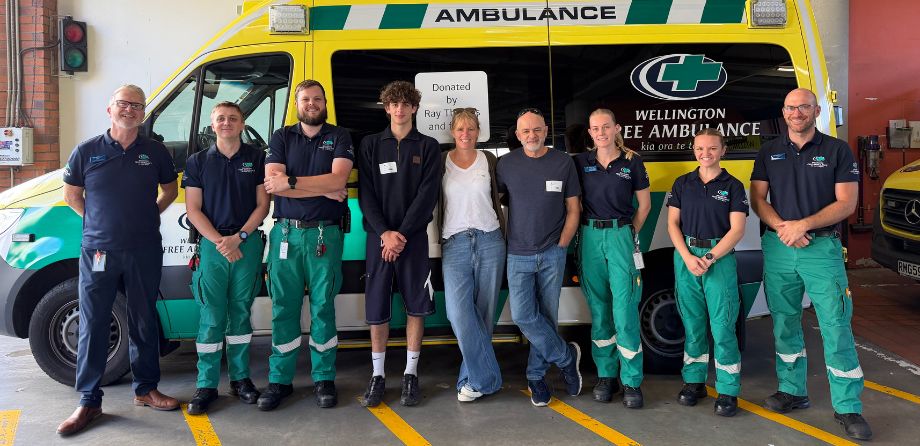
Fred and Jill met some of his team of lifesavers. L-R: Wellington Community Liaison Nick, Paramedic Jack, Supervised Paramedic Rob, Jill's son Lachie, Jill, Fred, Paramedic Kelsie, Paramedic Janien, Critical Care Paramedic Sam
It was a weeknight evening like any other. After a busy day, Jill and Fred were in bed, preparing for sleep. Fred said goodnight before the night took a completely unexpected and life-threatening turn.
Jill explains, “about 30 seconds after Fred said goodnight, he started to make this weird sort of gurgling noise. I thought he was falling asleep, snoring a little bit then catching his breath. I asked him if he was ok, but he didn’t answer me and kept making the noise”.
Jill turned the light on and saw that Fred’s eyes had rolled back into his head. She started shaking Fred, asking him if he was ok.
“He was clearly not ok.”
Starting the chain of survival
Jill swung into action straightaway. She rang 111 and began doing CPR – even before being instructed to do so. She’d started the chain of survival, which is key to increasing someone’s chances of surviving a sudden cardiac arrest. It involves recognising someone is experiencing a sudden cardiac arrest, prompt calling of 111, CPR and defibrillation without delay, fast ambulance arrival, and further advanced care from paramedics.
Jill says: “I think I went onto auto-pilot. I’d done a CPR course a while back and I thought Fred wasn’t breathing so I just assumed I needed to do CPR. I never even checked for a pulse or anything like that. He was in a really bad state.”
The 111 call taker could hear the noise Fred was making and told Jill to move him from the bed onto the floor and continue to do CPR: an extra challenge for Jill who had a cast on her wrist, having broken it the month before, mountain biking.
Jill recalls hearing Fred making gasping noises when she was performing CPR. When she stopped so she could open the door for the paramedics – only Jill and Fred were at home at the time – “he stopped making any noise and was this horrible grey colour”.
“When I started doing CPR again, he went back to doing the weird noise and his colour came back a little bit. It encouraged me. I thought ‘at least this is doing something’.”
‘Absolute relief’
The 111 call taker kept Jill informed about where the ambulance was, including when the paramedics were coming up the driveway.
“As soon as they walked in, I stepped back”, Jill recalls.
“It was an absolute relief to see them.”
As Wellington Free Ambulance crews arrived (including Critical Care Paramedic Sam, Paramedics Jack, Kelsie and Janien, and Supervised Paramedic Rob) alongside local Fire and Emergency NZ crews, Wellington Free Ambulance Community Liaison Nick turned up too.
He’d responded to a GoodSAM alert.
The GoodSAM Responder app alerts CPR-trained members of the public to incidents of sudden cardiac arrest close by, allowing them to respond and provide good quality CPR before our crews and other emergency services arrive.
Jill laughs when remembering Nick turning up - “I thought he was just some poor person who’d wandered in off the street! He said he lived around the corner, so I thought he was a random neighbour who saw the flashing lights and decided to come and help.”
“Nick was amazing. He asked if I wanted a cup of tea and if there was anyone he could call. I think by then it was quite chaotic. The firefighters were there, so were the paramedics. Nick was really just trying to keep me calm.”
‘Firing up over and over and over again’
Nick sat with Jill while crews cared for Fred in their bedroom. Jill’s son Lachie, who had been staying at his girlfriend’s house that night, had arrived by now.
Paramedic Kelsie and Supervised Paramedic Rob remember that it was a ‘rainy, miserable night’. When the team arrived, one of the first things they did was perform an ECG (electrocardiogram) on Fred. This quick test records the electrical activity of your heart. It showed that he had had a massive sudden cardiac arrest.
“I was just sitting there, listening to the defibrillator beeping, firing up over and over and over again. It would have been half an hour plus they’d been trying to restart his heart”, Jill explains.
Kelsie and Rob confirm that they were doing CPR on Fred for over 30 minutes. “It wasn’t looking good and we told the family there was a high chance that if he survived, he would never be the same again. The colour drained from Jill’s face.”
However, Fred’s heart stayed in a shockable rhythm which allowed the team to keep performing shocks with a defibrillator. The team remained concerned that his steady heartbeat wasn’t returning.
Jill remembers that “[Paramedic] Jack came in and said they couldn’t get a heartbeat. I thought ‘oh, that’s it then’.
“But then he came back in a few minutes later and said they’d managed to get a pulse, so they were prepping him for hospital.
“About five minutes later, Jack came in and said it’d stopped again.
“Then he returned and said it’s going again.”
Once the team got Fred’s heartbeat into a steady rhythm, they kept him comfortable and sedated as they transferred him to hospital.
When they were in the ambulance, Jill remembers Paramedic Kelsie gently preparing her for the worst.
“She told me because Fred’s brain had been starved of oxygen for so long, the paramedics didn’t expect this to be a good outcome. He’d been without oxygen for a really long time, so even though they’d got his heart beating, she told me, ‘don’t get your hopes up too much’.”
Jill remembers that night, “it was absolutely pouring down. As we were in the ambulance driving to the hospital [Paramedic] Jack was taking it steady. In my head, I was going ‘can you go a bit quicker?!’ even as the radio frequently warned the paramedics to watch out for surface flooding.”
36 hours in a coma
For Fred, his memories of that night start when he woke up in the hospital – after spending 36 hours in a coma.
“The first thing I remember is waking up to a doctor asking, ‘do you know where you are?’ Due to the pain relief I was on, for the first couple of days when I looked at Jill’s and my daughter Kate’s faces, they were like cartoon characters.”
“He kept asking ‘are you AI?’ That was his first sentence”, Jill laughs.
Fred remembers only snippets of those first few days.
The doctors confirmed that Fred had had a massive sudden cardiac arrest. He underwent surgery to insert a single stent (a tiny, expandable, mesh-like metal tube) into a coronary artery (a vessel that supplies blood to the heart) to keep it open.
In total, Fred spent three weeks in hospital, and due to the lack of mobility, lost 14kg of muscle mass. On top of that, when Jill gave him CPR, due to the cast on her broken wrist, she managed to break 12 of his ribs and his sternum. He says even though there’s ongoing pain from the broken ribs and sternum, it was worth it to still be alive.
It can happen to anyone, any time
Reflecting on his experience, Fred admits it was all “weird. I wasn’t at risk for a sudden cardiac arrest. It goes to show you just don’t know if and when it’ll happen to you.”
Fred didn’t have any risk factors for heart issues. He was fit (a keen mountain biker) and healthy. He ate well, didn’t smoke and had no history of heart problems – “no red flags at all!”, Fred jokes. “I’m not a poster child for sudden cardiac arrest.”
That’s why he still feels very shocked by what happened but thankful to be alive.
So thankful in fact, that when he was just out of his coma and Jill explained what had happened, including that she performed CPR on him, he simply said: thank you.
In total, Fred needed eight shocks from the defibrillator to reestablish his heart rhythm.
Jill describes how she was “completely blown away” by the experience. “It was amazing having the paramedics, firefighters and Nick there. The paramedics kept coming in and keeping us informed. Fred was obviously the priority but the fact that the paramedics were taking the time to talk to us made such a difference.”
“It was a completely surreal and terrifying experience. But reflecting back on it, I think the care that the paramedics give to wider family is bloody amazing. The emergency department and intensive care doctors were the same – the care that they take to keep families informed is really amazing.”
Meeting some of his lifesavers
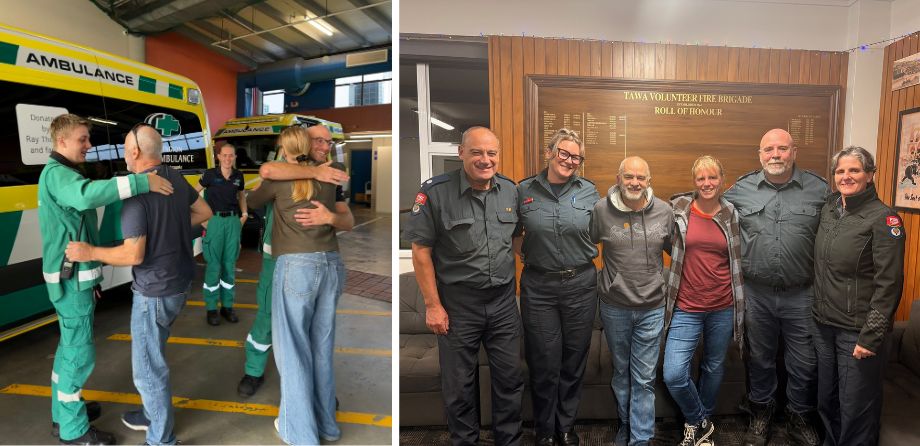
As well as meeting some of the Wellington Free Ambulance team, Jill and Fred met some of the firefighters who helped save his life
In April, 10 weeks after his sudden cardiac arrest, Jill and Fred were reunited with some of his team of lifesavers at our Thorndon Ambulance Station. Around 12 people were involved in Fred’s care on the night, including 5 paramedics,1 member of Wellington Free staff, and 6 firefighters.
Jill describes this moment as “pretty special. I have hazy memories of what the team looked like, and I wasn’t sure if I’d recognise them again – but I did. It was great to say thank you to them.”
“Thank you for being there and not giving up.”
Fred explains how, 10 weeks on, “it feels like another lifetime ago, but also like it was just yesterday. It was mind-blowing to meet some of the people who saved my life. I didn’t realise there were so many. It seems like a lot of people there for me.”
“How do I thank them for something like that, saving my life?”
Although Fred is still very sore from his broken ribs and sternum, he believes meeting the team is “good for closure. It helps us both to work through it. Jill and I are talking a lot about what happened”.
Jill admits that going back to the house was “weird. Everything had been thrown out of the room; the bed was in pieces. But the firefighters put it all back together, so when I got back to the house, it was all immaculate. It’s pretty amazing, going the extra mile to do that.”
“I was so grateful that the ambulance got there so quickly. It was an absolute relief when that door opened, and I heard them shout ‘paramedics’. It had been pretty scary being there all by myself. The paramedics turning up made me feel like I was being supported by a group of people who knew what they were doing.”
For the Wellington Free team who met Jill and Fred, the overall feeling was one of shock. Shock that Fred had survived with no long-term health complications or neurological issues, especially considering how unusually low his blood oxygen levels had been.
“It was amazing to see him again, none of us thought that Fred would make it.”
Essential advice for everyone
Back working part time now, Fred is experiencing ongoing fatigue that will ease as his body continues to heal. He’s also attending a weekly cardiac rehabilitation programme at his local hospital that will help him recover, both physically and mentally.
When asked what advice he’d give to everyone in the Greater Wellington and Wairarapa region about sudden cardiac arrests, Fred says: “get the free CPR training. It was a lifesaver for me”.
Fred’s experience shows how sudden cardiac arrests can happen to anyone, at any time – even if you’re fit and healthy. His sudden cardiac arrest happened at home, like 69% of the out-of-hospital sudden cardiac arrests we attended in the last year alone (*). Last year, just 15% of patients survived a sudden cardiac arrest outside of hospital (*). Jill’s early use of CPR was lifesaving.
Learn how to save a life with CPR and an AED by booking your free The Lloyd Morrison Foundation Heartbeat training session now.
*Source: Wellington Free Ambulance Out-of-Hospital Cardiac Arrest Registry 2024/2025.