About us
Our news
Meet Prashanta - a second chance at life
Meet Prashanta - a second chance at life
 06 October 2026
Meet Prashanta - A second chance at life
"My family and I express deep gratitude for bringing me back to life and keeping me alive."
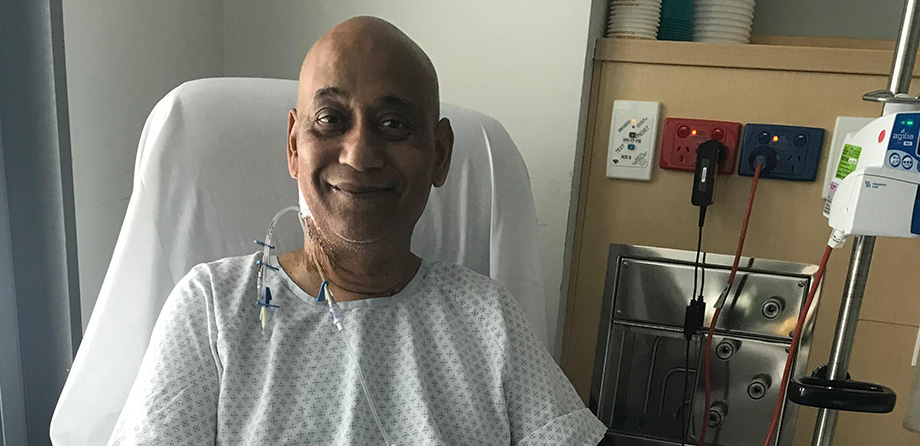
The last thing Prashanta remembers from 17 January 2022 is picking books from the back seat of his car.
He had driven to the Salvation Army store in Miramar to drop off some books, placing them on the racks outside the store.
His next memory is waking up in ICU three days later. Prashanta had suffered a cardiac arrest while he was alone just outside the store. He has no memory of the cardiac arrest or of the moments that followed. What he does know has been pieced together from what he was told later.
Salvation Army staff and passerby’s assisted Prashanta and the Wellington Free Ambulance crew arrived in minutes. They performed CPR and administered a shock while taking Prashanta to Wellington Hospital Emergency Department.
He understands he had been in cardiac arrest for 28 minutes before reaching ED, with paramedics providing care for much of that time. “I am very grateful for the support and care they provided.” In ED, he became unstable and had another arrest, four rounds of CPR and a further 20 minutes downtime.
The cardiac arrest came just weeks after Prashanta had first been examined by a cardiologist. In December 2021, he had experienced shortness of breath and underwent several tests. He was advised that he had a bicuspid aortic valve (a congenital heart condition where the aortic valve has only two flaps (cusps) instead of the normal three), which would need to be repaired, and further tests had been scheduled for February 2022.
Those tests were still weeks away when Prashanta suffered his cardiac arrest in January.
He later underwent open heart surgery. Physically, he describes his recovery as quite uneventful, with completing the cardiac rehabilitation programme being an important part of his recovery.
Work was also important to Prashanta, and he was keen to return to work full time soon after coming home from surgery. Looking back, he noticed subtle changes in his ability to manage stress and feels he should not have started work so soon.
The experience has changed the way he looks at life. “The key change has been that I now appreciate how fragile and unpredictable life is.”
Prashanta describes himself as usually being a very precise person who expects things to happen in a predictable and orderly manner. His cardiac arrest has helped him accept more randomness.
His regular blood tests and the sound of his mechanical valve ticking away are reminders of what he has come through.
Prashanta is immensely thankful for the timely help and care he received from the paramedics and hopes to thank them personally.
“I know you do a very demanding and stressful job, and my family and I express deep gratitude to you for bringing me back to life and keeping me alive for a long time before the specialist teams at ED attended to me.”
For other cardiac arrest survivors, Prashanta encourages them to be grateful for everything and to accept that some things, physically, emotionally, or both, may have changed forever. “Don’t fight it and go with the flow.”
He also has a message for whānau and friends of cardiac arrest survivors. A survivor’s outlook on life may have changed, and they may not always react or respond to things in the same way they did before. “Please accept this change and try to let them live their second life.”
And for the wider community, Prashanta has a simple message: learn CPR, know who in your neighbourhood knows CPR, and know where your nearest AED is located, because it can save a life.