About us
Our news
A question and answer with Supervised Paramedic Kerry
A question and answer with Supervised Paramedic Kerry
 24 August 2026
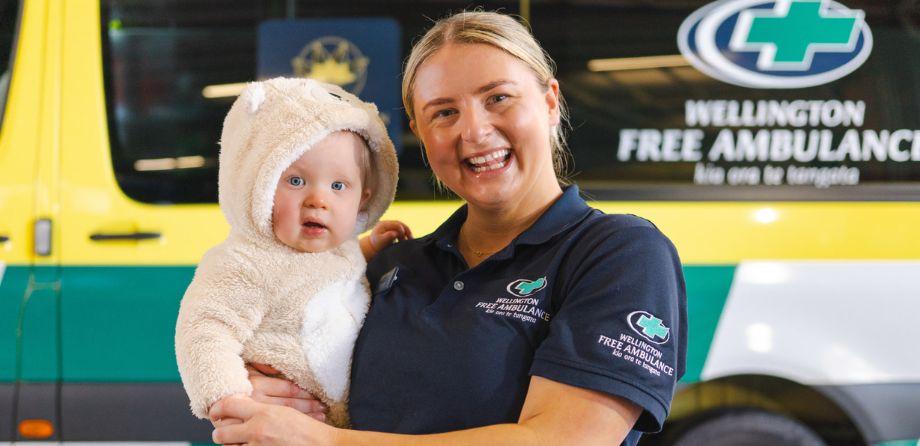
Supervised Paramedic Kerry is one of the paramedic stars of Onesie 2026! Here she talks about finding purpose as a paramedic and mum.
Q: How long have you been a paramedic?
I worked in hospitality for over six years before becoming a lifeguard, where I discovered my passion for first aid and helping people. I started my paramedicine degree in 2020 and volunteered with Wellington Free Ambulance during the pandemic. After two years in Patient Transfer Services, I became a graduate paramedic and have now worked on the road for about 1.5 years, including six months since returning after having my baby.
Q: Why paramedicine?
I was inspired to become a paramedic after meeting a friend who was studying paramedicine, but personal experiences also played a big role. Losing my brother at 20 showed me how important support can be during difficult times and made me want to help other families. Wellington Free Ambulance also cared for my grandma after she had a stroke, and the compassion they showed left a lasting impression. It made me want to be part of an organisation that supports people when they need it most.
Q: What does it mean to you personally to be juggling the demands of frontline work while raising a young child?
It’s a juggle. I work a three days on, three days off roster, and my shifts are always changing, so every week looks a little different. On a 10am–10pm shift, I’m still up at 6am getting my daughter, Daisy, ready for daycare before dropping her off. Then I head home to get myself and my lunch organised before starting a 12-hour shift. Other days I might be working 6am–6pm or starting a night shift, so it takes a lot of planning.
My partner and I plan the month ahead to make it work. There are days when I can’t do daycare pick-up because I’m at work, so we share those responsibilities. Daisy is 11 months old now, and I really cherish my days off with her. Those days together are so important, and I make the most of every moment we have as a family.
Q: What helps you switch between ‘paramedic mode’ and ‘mum mode’, and how easy is it to separate the two?
I’m getting into more of a rhythm now. It was harder when I first came back in January, but I’m about six months in now. I usually start to switch off on the drive home and use that time to wind down from my shift. When I get home, I take my boots and uniform off straight away and have a shower, which really helps me reset and switch into mum mode.
As soon as I give Daisy a hug, I’m in mum mode. I just try to leave work at work, and it’s really nice being able to come home to her. On my days off, we love getting out and about together. We go to the Sunday markets, walk along the waterfront, and she enjoys swimming, going to the playground and visiting the library. She’s very adventurous and has even been up Mount Kaukau a few times. It’s nice being active and spending that time together.
Q: What advice would you give to other soon-to-be working mums who are preparing to balance a new baby with a demanding career?
Be kind to yourself when you first return to work. You’ve just been through a life-changing experience, and it takes time to adjust. Surround yourself with other mums who’ve been through it or are going through it, and lean on them for support and advice. Having a good support network makes a big difference.
Give yourself time to settle back in, because you’re coming back as a different person and your priorities have changed. There can be moments of guilt about not being with your baby all the time, but remember that working mums can also be strong role models. I want my daughter to see that you can work hard and do both, even when it’s not always easy.
Q: What does a good day look like for you?
A good day is when you go to a patient and it reminds you why you do the job. They’re just lovely and those interactions in the community are what make it so meaningful. Today, we were even given limes off someone’s tree and biscuits, which was really kind, it’s those moments that stay with you.
I have great colleagues. I really enjoy working with the team. I learn a lot from them. They're super positive and we work well together, which makes the day even better.
It’s those combinations - great people, great colleagues and meaningful patient interactions - that make a good day for me.
Q: What are the challenges of working as a paramedic?
The work itself can be really challenging depending on the types of patients you attend.
When you’ve had a hard shift, especially difficult or traumatic jobs, switching off can be tough. For me, the drive home and having a shower helps me decompress. I also have a couple of colleagues I can message or talk to about jobs like that. We’ll check in with each other, and sometimes it turns into a coffee and a chat. Having that support and being able to talk things through with trusted colleagues is important in this job.
I think if you don’t have that support, it would be difficult. You need people you can rely on.
You also must be proactive about looking after yourself, because sometimes things can sit with you more than you realise.
Q: What gives you value from your work?
The relationship with my colleagues is a big one, they’ve become real friends. I really value the teamwork and support on shift.
I also enjoy meeting people in the community. You come across all walks of life, and a lot of the time you meet lovely people. You learn something from them every day, which I find interesting.
Since coming back to work as a mum, connecting with other mums at work has also been important. There’s a small group of us and it’s been so helpful having people who are at the same life stage and understand what it’s like. I really look up to them, seeing that you can be a paramedic and a mum has been really encouraging for me.
Support paramedics like Kerry by donating to this year's Onesie Appeal.